
About 85% of buildings in a National Register district
Concrete Contractors in Galena, IL
Walks, steps, patios and drives planned around historic review and flood history.
- We come out, measure and hand you an itemized price in writing
- Exterior pours use air-entrained concrete with joints laid out before the truck arrives
- Dubuque right-of-way permits and sidewalk notices are part of the job, not an afterthought
Concrete in a Historic River Town
Concrete Contractors in Galena have a review step most towns do not. The Galena Historic District, listed on the National Register, takes in roughly 85 percent of the city's structures. The City of Galena's building department says all exterior work on any home in the Historic District requires a Certificate of Appropriateness. Minor changes can usually be approved when you apply, and bigger ones will likely go before the city to be presented. The 2020 census counted 3,308 people.
What historic review means for concrete
A new front walk, a set of steps or a driveway is exterior work, so expect it to need review if your home is in the district. In our experience planning these jobs, it helps to:
- Describe the materials plainly: color, finish, and whether any stamping or tint is planned
- Keep proportions in scale with the house and the street, especially on steps
- Leave time in the schedule for approval before the pour date
The city's FAQ notes that even exterior painting, which needs no building permit, still needs a Certificate of Appropriateness, so it is safest to assume concrete work does too. We write the scope and measurements so your application is easy to prepare.
Brick town, steep streets
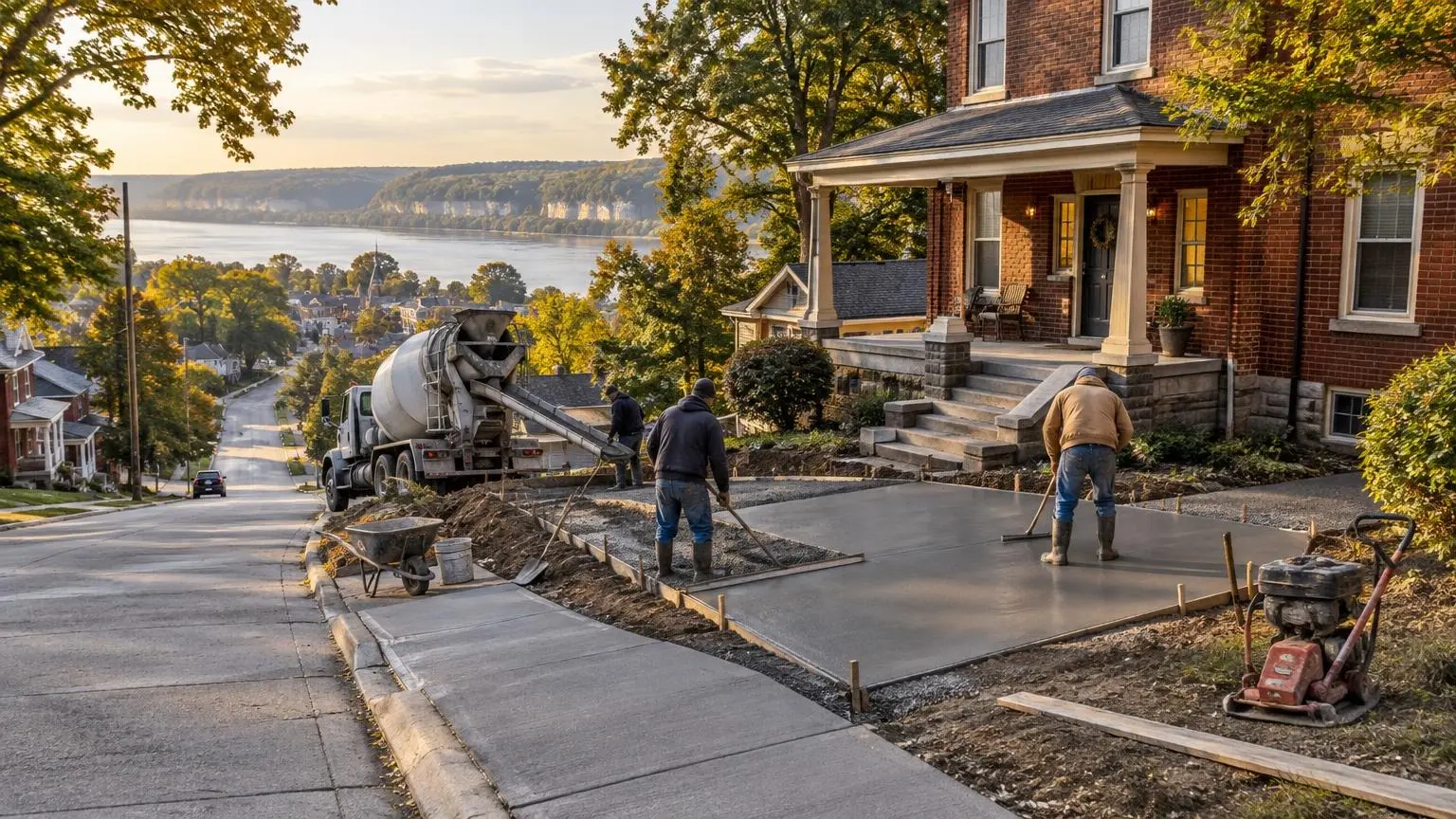
Galena's downtown is mostly brick, in part because zoning once restricted wood-frame buildings. Away from Main Street, homes climb the hillsides above the Galena River, with stone retaining walls, steep walks and steps cut into slopes. On these lots the base and the drainage do the heavy lifting. We dig to firm soil, compact crushed stone, and pitch each slab so water runs off rather than under.
Flood history and basements
Galena has recorded major floods in 1828, 1937, 1972, 1993, 2010 and 2011. Floodgates connected to the river levee date to 1951, and they did their job in 1993. When roughly eight inches of rain came down overnight on July 22, 2010, the gates held again, yet homes and businesses still reported water in basements. Flatwork plays a part in keeping water away from foundations. Patios and walks along a house should fall away from it, with a sealed isolation joint where slab meets wall, and downspouts should discharge beyond the slab, not onto it.
Winter on the hills
Average snowfall is 37.9 inches, and the thermometer has reached -35°F. On steep walks and steps, a broom texture is a safety feature. Every outdoor pour gets an air-entrained mix, and we recommend sand rather than rock salt during the first winter.
The Fever River name
The Galena River was once called the Fever River in early documents, a name that did not stick. The river shaped the town's layout: the flat ground by the water filled with brick commercial buildings, and homes stepped up the bluffs on either side. That is why so much residential concrete in Galena is either a short, steep walk from a sidewalk to a raised porch or a stair run between terraces. For those, we pay as much attention to the landing and handrail anchors as to the treads.
Matching a historic street
New concrete next to old brick, limestone and weathered walks can look stark at first. Plain gray concrete darkens as it ages. Where a softer look is wanted, an exposed aggregate finish or an integral color in a muted tone can sit more comfortably beside older materials, subject to what the historic review approves.
Outside the district
Newer homes outside the district still need a building permit for many projects, and we ask the city what your address needs before we put it on the calendar.
Galena Facts for Homeowners
- Certificate of Appropriateness. The City of Galena requires a Certificate of Appropriateness for all exterior work on any home in the Historic District.
- Mostly historic. About 85 percent of Galena's structures are in the Galena Historic District; zoning limits on wood-frame buildings helped make brick common.
- Floods and floodgates. The levee floodgates date to 1951. After about eight inches of overnight rain on July 22, 2010, homes and businesses reported basement damage.
- Winter. Snowfall averages 37.9 inches a year; the coldest recorded reading is -35°F.
Galena Questions
Does a new walk need historic approval in Galena?
For homes in the district, the city says any exterior work needs a Certificate of Appropriateness. Minor changes are often approved at application.
Can new concrete help keep water out of my basement?
It can help. Slabs along the house should fall away from it, with a sealed joint at the wall and downspouts carried past the slab.
Is stamped or colored concrete allowed in the district?
That is a question for the review. We describe the color and finish clearly so the city can decide.
Free Estimates in Galena, IL
Free estimates in Galena, inside and outside the Historic District.
Concrete Contractors Near Galena
- Concrete Contractors in Dubuque, IA
- Concrete Contractors in Asbury, IA
- Concrete Contractors in Peosta, IA
- Concrete Contractors in Epworth, IA
- Concrete Contractors in Farley, IA
- Concrete Contractors in Dyersville, IA
- Concrete Contractors in Cascade, IA
- Concrete Contractors in Bellevue, IA
- Concrete Contractors in East Dubuque, IL
- Concrete Contractors in The Galena Territory, IL
- Concrete Contractors in Elizabeth, IL
- Concrete Contractors in Hanover, IL
- Concrete Contractors in Scales Mound, IL
- Concrete Contractors in Platteville, WI
- Concrete Contractors in Cuba City, WI
- Concrete Contractors in Hazel Green, WI
- Concrete Contractors in Dickeyville, WI
- Concrete Contractors in Kieler, WI
- Concrete Contractors in Potosi, WI
- Concrete Contractors in Lancaster, WI
- Concrete Contractors in Benton, WI